Scorekeeper Duties and Guidelines
15 July 2015
Scorekeeper's Quick Guide (printable PDF)
- 1 Scoreboard
- 2 Scoresheet
- 2.1 Attendance
- 2.2 Record Names of Referees and Scorekeeper(s)
- 2.3 Control the Game Clock
- 2.4 Control Intermissions and Warm-Up Periods
- 2.5 Record Team Timeouts
- 2.6 Record Shots on Goal
- 2.7 Record Goals and Assists
- 2.8 Record Penalties
- 2.9 Control the Penalty Clocks
- 2.10 Inform Referees of Penalty Area Infractions
- 2.11 Record the Outcome of Shootouts
- 2.12 Suggest Three Stars of the Game with Input from Referees
- 3 Scoresheet
1 Scoreboard
Scoreboard controller

Setup at beginning of session:
- Retrieve the scoreboard controller from the SDFHL storage locker.
- Flip the scoreboard power switch mounted on the wall directly below the scoreboard. If necessary, use the small key stored with the scoreboard controller to unlock the power switch lock-box.
- Once zeroes appear on the scoreboard, turn on the scoreboard controller.
The scoreboard is used to maintain the following:
- Game clock
- To start and stop the game clock, press the green STOP/GO button by the numeric keypad.
- To set the game clock, make sure it is not running and push the white TIME button, followed by a four-digit time (e.g., 1 0 0 0 to set 10 minutesli or 0 5 0 0 to set 5 minutes).
- The horn will automatically sound when the game clock reaches zero.
- Period
- To adjust the period, push the red PERIOD button by the numeric keypad, and it will cycle through four periods.
- Score
- To add a single goal, tap the corresponding HOME or GUEST button.
- To remove goals, press and hold the corresponding HOME or GUEST button.
- To enter a specific number of goals, tap the corresponding HOME or GUEST button, then type a two-digit number on the numeric keypad.
- Penalty clocks
- To enter a penalty time, make sure the clock is not running and push the PLYR-PENALTY button on the corresponding HOME or GUEST side of the controller. Next, enter an arbitrary two-digit player number (e.g., 0 1 for player #1). Then, enter a four-digit time (e.g., 0 2 0 0 for a two-minute penalty).
- To clear a penalty, push the PLYR-PENALTY button on the corresponding HOME or GUEST side of the controller. Next, enter the two-digit player number (e.g., 0 1). Finally, enter 0 0 0 0 to clear the time.
- Shots on goal (These will only appear on the controller display—not on the main scoreboard--and it may be easier to record these directly on the paper scoresheet)
- To add a shot on goal, tap the SHOTS ON GOAL button on the corresponding HOME or GUEST side of the controller.
- To remove shots on goal, press and hold the SHOTS ON GOAL button on the corresponding HOME or GUEST side of the controller.
- To enter a specific number of shots on goals tap the corresponding SHOTS ON GOAL button on the corresponding HOME or GUEST side of the controller, then type a two-digit number on the numeric keypad.
2 Scoresheet
2.1 Attendance
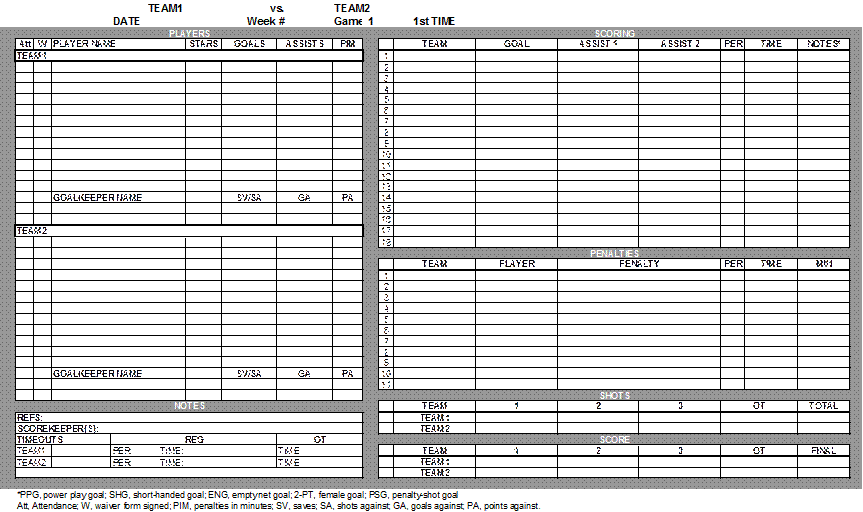
Take attendance for both teams in the PLAYERS area of the score sheet by checking the Att box to the left of each player who is in attendance. Note any goalkeeper or player substitutions by writing their name in a blank space. Note the period and time on the game clock if there is an in-game goalkeeper substitution.
2.2 Record Names of Referees and Scorekeeper(s)
Verify/record in the NOTES area of the score sheet the names of all of the Referees and Scorekeeper(s) who participate in the game, including when Referees substitute for each other during the game. Note the period and time on the game clock if there is an in-game Referee substitution.
2.3 Control the Game Clock
Control the game clock..
- In the regular season, there are three 10-minute regulation periods with no overtime.
- In the playoffs, if the score is tied at the end of the three regulation periods, there is a 5-minute sudden-death overtime period.
- The game clock stops at each blow of the whistle for all of these periods. The game clock is re-started when the ball is dropped at the ensuing face-off.
- If the main scoreboard is not working, maintain the game clock on a separate timer and use the following guidelines to inform others of time remaining:
- Automatically shout out the game clock time at approximately 5-minutes, 3-minutes, 1-minute, 30-seconds and 10-seconds remaining, then count down the final 5 seconds, when practical.
- Upon request from the Referees or players, inform them of the time remaining on the game clock, when practical. If one team asks, also inform the other team.
2.4 Control Intermissions and Warm-Up Periods
Prior to the start of the game, set the game clock to 5 minutes for the warm-up period. With one minute remaining in the warm-up period, inform the referees to call for the balls.
At the conclusion of each period, set 2 minutes on the game clock for the period intermission. With 30 seconds left, inform the officials to request the teams to line up for the face off.
2.5 Record Shots on Goal
Record shots on goal with hash marks in the SHOTS area of the score sheet for each team as they occur or at the end of the period if the shot counter is used. At the end of the game, calculate the total shots on goal for each team. Shots on goal are determined at the discretion of each Scorekeeper, but in an attempt to maintain consistency between Scorekeepers, please use the following examples.
Counted as a shot on goal:
- Awarded goal where the ball crosses the goal line within the goal frame.
- The ball is directed toward the goal frame in a manner that would have resulted in a goal had the goalkeeper not directly intervened to make a save.
- Penalty shots that meet the above criteria.
- The team that wins a shootout is awarded one shot on goal and one awarded goal, but none of the other shots in the shootout count as shots or goals.
Not counted as a shot on goal:
- The shot is stopped by a player other than the goalkeeper.
- The ball directly hits the goal frame and does not result in a goal.
- The goalkeeper plays the ball, but the ball was outside of the goal frame such that it would not have resulted in a goal had the goalkeeper not played it.
- Goal automatically awarded due to an infraction.
2.6 Record Goals and Assists
Record goals and assists in the SCORING area of the score sheet.
1) In the spaces provided, record the team’s color, the goal scorer’s name, the name(s) of the player(s) awarded assist(s), the period, and the time remaining on the game clock.
2) In the NOTES column, record special information of the following types of goals:
a) ENG – empty-net goal (Goal scored when the goalkeeper is on the bench to allow an extra attacking player.)
b) PPG – power-play goal (Goal scored by a team that has more players on the rink than the opposing team due to a penalty situation. If both teams have penalized players, but the same number of players on the rink, goals are not considered PPG.)
c) SHG – short-handed goal (Goal scored by a team that has fewer players on the rink than the opposing team due to a penalty situation. If both teams have penalized players, but the same number of players on the rink, goals are not considered SHG.)
d) PSG – penalty shot goal (Goal scored during a penalty shot. Note that penalty shots are also recorded in the PENALTIES area of the score sheet regardless of whether they result in a goal.)
3) At the end of each period calculate the total points scored for each team, and at the end of the game calculate the final score for the SCORE area of the score sheet.
2.7 Record Penalties
Record penalties and penalty shots in the PENALTIES area of the score sheet
- In the spaces provided, record the penalized team’s color, the player’s name, the penalty type (as reported by the Referees), the period, and the time remaining on the game clock.
- For penalties committed by a team in general, as opposed to an individual player (e.g., too many players), the word “bench” should be used in place of a player’s name.
- There are five different penalty types that result in different penalty times to be recorded in the MIN column: minor (2 min), double-minor (4-min), major (5-min), misconduct (10-min), and game misconduct (10-min). A game misconduct actually results in immediate ejection from game, but 10 minutes are recorded on the score sheet.
- If the penalty was a bench penalty or served by a teammate who did not commit the penalty, write “served by” followed by the serving player’s name next to the penalty listing.
2.8 Control the Penalty Clocks
1) Minor penalties
a) Reguar minor (most common) – 2 minutes should be put on the penalty clock.
b) Double-minor – 4 minutes should be put on the penalty clock. If a power-play goal is scored during the first 2 minutes, then the penalty clock should be reset to 2 minutes remaining.
c) Early expiration of minor penalties due to a power-play goal (PPG) – If a team with more players on the rink scores (PPG), a minor penalty on a player from the short-handed team may immediately expire. If more than one minor penalty is being served, typically the minor with the least amount of time remaining will be the one to expire. In the case of a double-minor, if the PPG was scored when there was more than 2 minutes left, the penalty time is reduced to 2 minutes, and if the PPG was scored when there was less than 2 minutes left, the player can resume play immediately.
2) Major penalty – For a major penalty, 5 minutes should be put on the penalty clock, and a teammate must serve. The penalized player also automatically receives a game misconduct (ejection from the game), which should be recorded separately as described below. Unlike minor penalties, there is no early expiration regardless of how many goals are scored.
3) Game misconduct – The player is ejected, so there is no need to keep track of penalty time.
4) 10-minute misconduct – The game time of the eventual expiration of the penalty should be noted, and the player should be informed that they are not allowed to resume play until the first stoppage of play after that game time is reached. If any minor penalties were called on the same player, the Captain shall designate a floor player who was on the rink at the time the penalty was committed to serve them, and the 10-minute penalty time does not start until all other penalty time has been served by the teammate.
5) Special penalty situations. In the following situations, the Scorekeeper should ensure that the Referees, the players, and they all understand exactly how the penalties are to be served.
a) Coincidental penalties – This is when penalties are called on players from both teams at the same stoppage of play. It is the responsibility of the Referees to determine how these penalties will be served based on our Rule Book, because special rules can apply. For example, unlike regular penalties, no player serving a coincidental penalty can return to play before the penalty expires, even if a goal is scored. In addition, in some cases, the penalized players will not be allowed to return to play until after the first stoppage of play after the penalty expires.
b) Teammate serving penalty – When one player commits multiple penalties at the same stoppage of play, it is sometimes necessary to have a teammate serve one or more of the penalties immediately, but then the offending player must stay in the penalty box for the entire duration of their penalty time. The name of the player serving the penalties can also be recorded on the scoresheet.
c) Four minor penalties – If a single player accumulates four minor penalties (double-minors counting as two penalties), they will receive an automatic game misconduct, which should be recorded separately, as described above. The Scorekeeper should inform the Referees when the fourth penalty occurs for enforcement of this rule.
If the scoreboard is used, players are responsible for monitoring the time left on the penalty. Scorekeepers should remind the penalized player not to leave the penalty box early.
If the scoreboard is not working and a separate timer is used, inform the Referees and players of penalty time remaining. Shout out time remaining at 2-minutes (for a major), 1-minute, 30-seconds, and 10-seconds. At the expiration of the penalty, say “GO.” Do NOT count down the end of a penalty. The only time you would inform anyone of the time remaining after your 10-second notification is if there is a stoppage of play. This is to ensure that the penalized player does not exit the penalty area early, and to prevent confusion about whether you are counting down the period or a penalty.
2.9 Inform Referees of Penalty Area Infractions
Inform the Referees at the next stoppage of play if a penalized player leaves the penalty box early, or if penalized players are engaging in unsportsmanlike conduct, such as verbal or physical aggression or altercations.
2.10 Record Team Timeouts
Record team timeouts in the NOTES area of the score sheet. When a team calls a timeout, a Referee will blow their whistle to verify the timeout Record the period and game time remaining next to the appropriate team. Each team is allowed only one timeout in the three regulation periods and one additional timeout in overtime, if applicable.
2.11 Record the Outcome of Shootouts
If a playoff game ends in a tie after an overtime period, a shootout will occur. The Captains will decide on a shooting order and a coin will be flipped to determine which team gets the choice of who goes first. On the back of the score sheet, record the shooting order for each team and designate the team that goes first. As the shootout proceeds, keep track of which players score and which do not. When the winner is determined, on the front of the score sheet, record one additional shot on goal in the overtime period, and record one goal awarded to “bench” to the winning team.
2.12 Suggest Three Stars of the Game with Input from Referees
The scorekeeper and/or Referees can indicate their suggestions for the three stars of the game under the STARS column on the score sheet.
3 Scoresheet